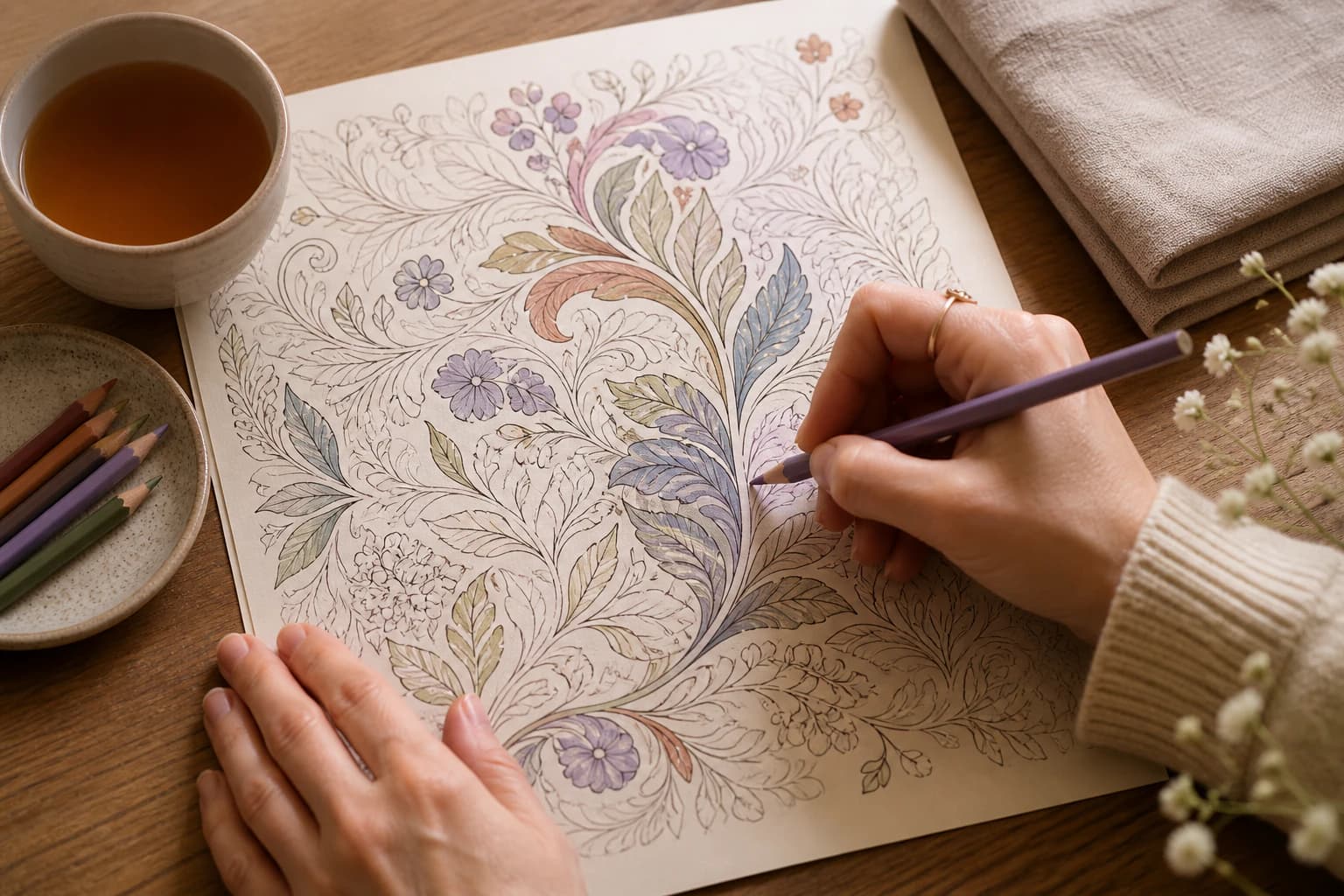
People often describe coloring as therapeutic because the activity can feel absorbing, orderly, and calming. That everyday use of the word matters—but it should not be confused with art therapy delivered by a trained professional or with treatment for a mental health condition.
Research offers encouraging signals alongside important limits. Some controlled studies have found short-term reductions in self-reported anxiety after coloring, while other work suggests that unguided coloring is not automatically a mindfulness practice and may perform similarly to free drawing.
Why a bounded creative task can feel settling
A coloring page provides structure without removing choice. The lines answer “where can I work?” while color answers “what do I want this to become?” That balance can make it easier to enter a focused state than facing a blank page.
Repetitive hand movements, visible progress, and a limited field of attention may also help create a pause from competing demands. You do not need to interpret every thought. For a while, your next decision can simply be green or blue, pencil or watercolor, continue or rest.
What studies suggest—and what they do not
A randomized emergency-department study reported a larger short-term decrease in anxiety scores for adults given coloring materials than for a placebo activity. Research with university students has also reported reduced test anxiety after coloring activities.
The broader picture is not absolute. A study comparing unguided mandala coloring with free drawing found both activities reduced anxiety similarly and did not find that coloring alone increased mindfulness. The responsible conclusion is that coloring can be a supportive leisure practice for some people—not a guaranteed clinical intervention.
How to make coloring more restorative
Approach the session as time you are allowed to inhabit, not another performance to grade. Choose a page whose complexity matches your energy. A simple page can be better on an overloaded day; an intricate pattern can suit a longer, quieter session.
- Begin with a short, realistic window such as ten or fifteen minutes.
- Notice the pressure of your hand and the visual change without forcing yourself to “clear your mind.”
- Use undo and editable copies to remove the fear of ruining an original.
- Stop if the activity becomes frustrating and try a simpler page or another kind of support.
A creative practice, not medical advice
Coloring can sit beside rest, movement, conversation, and other routines that support wellbeing. It does not replace professional care. If anxiety, low mood, or distress is persistent or affecting daily life, consider speaking with a qualified healthcare or mental-health professional in your area.
The value of a coloring practice does not depend on a dramatic outcome. A quieter fifteen minutes, a page you enjoyed making, and a reason to return tomorrow can be enough.